I Love Writing
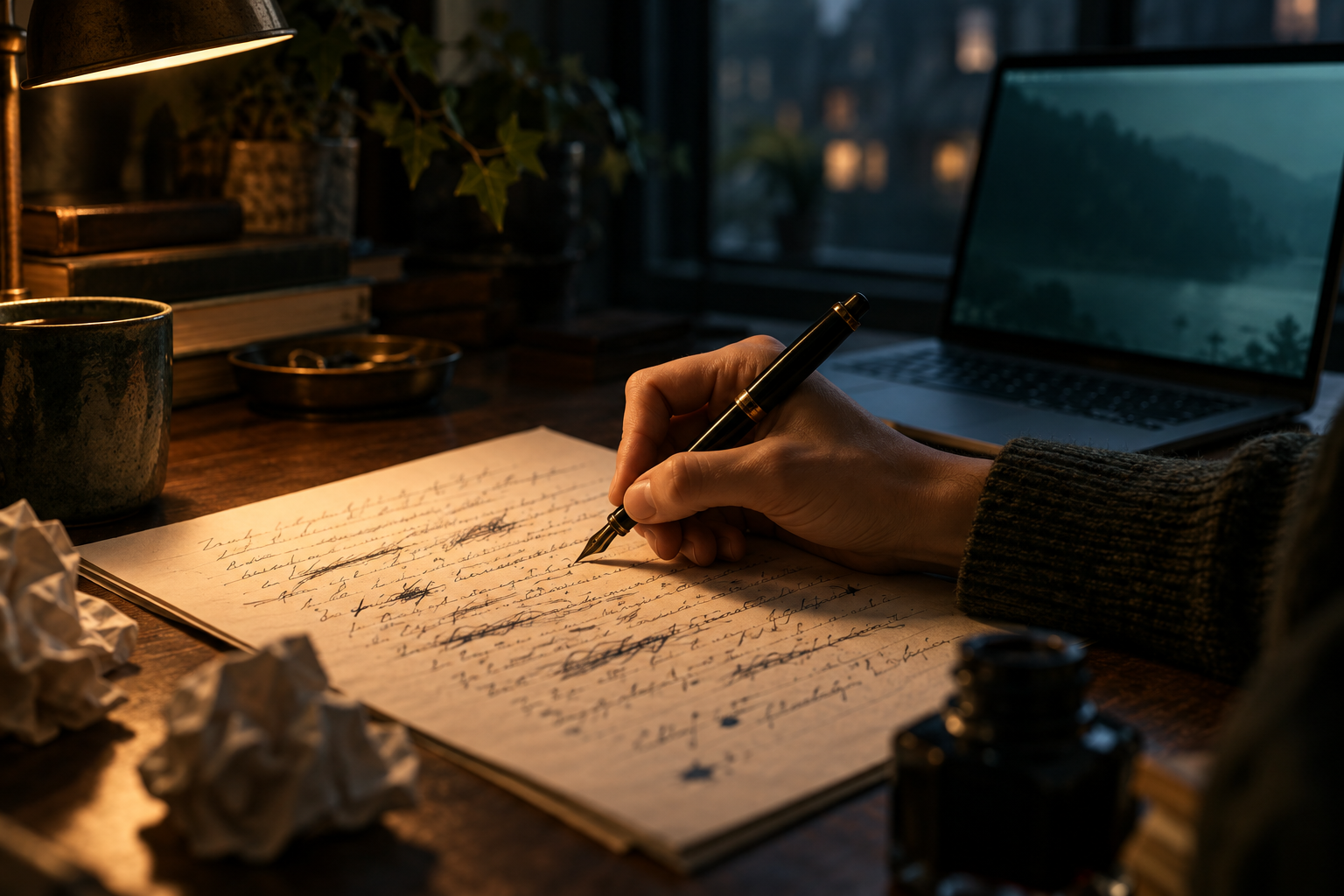
I love writing.
I know because I have been publishing more and somehow writing less.
That sentence sounds confused, but it is exactly what happened.
I still have ideas. I still put articles on this website. There are titles, paragraphs, cover images, links, all the visible evidence of a person who writes. Only now I can start with a loose thought, hand it to AI, argue with the result for an hour, and leave with an article that would once have taken me a week.
It is impressive. It is useful. And after doing it for a while, I noticed I was missing something.
I was missing writing.
Not the status of being a writer. Not clicking publish. The bit before all that. The stupid bit where one sentence takes twenty minutes because I know what I mean but cannot yet say it. The bit where a paragraph keeps going wrong and eventually exposes the fact that my idea is going wrong too. The small private shock when the right words finally turn up and I think, yes, that is it. That is what I have been trying to say.
That is the pleasure. I gave it away because the machine could do it faster.
The machine took the fun part
AI did not force itself into my writing. I invited it.
First it was for cleanup. Fix the grammar. Tighten this paragraph. Tell me where I repeat myself. All sensible uses, and still sensible now.
Then the requests grew.
Here is the idea. Flesh it out.
Make the argument stronger.
Add examples.
Give it a better ending.
Soon I was not bringing a draft. I was bringing a prompt. The machine produced the sentences and I stood over them like a foreman: keep this, cut that, less corporate, more like me, do not use that awful word, try again.
There is real work in that. You need taste to recognize a dead sentence. You need judgment to know when the argument has wandered off. Prompting is not nothing, editing is not nothing, and directing a piece can be demanding.
It just is not the thing I fell in love with.
I fell in love with making sentences. I became a person approving them.
And approval has a different feeling. You are outside the words. You inspect them. You may improve them, sometimes a lot, but you did not follow the thought into the dark and find them there. They arrived under fluorescent light, already arranged.
For ordinary work, this can be wonderful. Nobody needs to suffer artistically over release notes. But an essay is not only a container for information. At least mine are not. I write them because something has been bothering me and I want to get close enough to see its face.
If the answer arrives before I have done that, I get the article and lose the encounter.
Here is the embarrassing part
I just did it.
The essay “Nobody Gets to Be Everything” began with my idea. I had been thinking about how we demand perfection from impressive people while making endless allowances for ourselves. How the quality that makes somebody exceptional may live uncomfortably close to the quality that makes them difficult. How wisdom means accepting that light and shadow arrive in the same person.
I knew what I wanted to say. Then I used AI to help me say nearly all of it.
We researched examples. We expanded arguments. We found the Elon Musk quote that opens the piece. We fought over the design of the quote because the first version had a ridiculous underline and the second looked like a luxury funeral invitation. We made a cover. We tightened the page until it looked good.
I like the article. I mean that. The idea is mine and I stand behind it.
But the experience of making it felt more like directing than writing. I was choosing routes from the passenger seat. I got where I wanted to go, quickly, while touching the wheel only when the car drifted somewhere stupid.
Then I opened this article and did the same thing.
I told AI I wanted to write about loving writing. I asked it to flesh the idea out. It returned a handsome essay full of smooth contrasts, responsible caveats, neat headings, and sentences that sounded as if they had showered and put on cologne before leaving the house.
It was good.
It was also dead.
Worse, it was an essay about losing my voice to AI, written in the unmistakable voice of AI. The irony was difficult to miss.
So I complained that it sounded like AI. To AI.
And now we are here.
I am not going to fake purity. These sentences are still being worked on with a machine. Pretending otherwise would turn an honest problem into a branding exercise. I am using AI to help me understand how I want to use AI. The contradiction is real, and I suspect it will remain real.
What changed is that I can feel the difference now. I know when a sentence has merely passed my inspection and when it has passed through me.
Writing is how I catch myself lying
People say writing helps them think. That phrase is so common it has become easy to nod at and ignore.
What it means for me is that thoughts are cheats.
Inside my head, an idea can survive for months without being tested. It feels deep because it is attached to a strong emotion. It feels complete because nobody has asked it a precise question. Then I try to write it down and by the fourth sentence it is gasping for air.
Good.
That failure is the work.
Sometimes the sentence will not come because I do not know enough. Sometimes I am hiding behind a clever phrase. Sometimes I want two contradictory things and have been calling the confusion nuance. Writing catches me doing this. The page is less polite than the mind.
AI is often too eager to help me escape. It can take my vague feeling and build a respectable house around it before checking whether there is a foundation. The roof is straight. The rooms connect. There may be nothing underneath.
This is why the rough draft matters to me. Not because typing every word by hand is morally superior. It is not. The rough draft matters because it records the struggle between what I think I believe and what I can actually defend.
I need to be present for that struggle.
I am not throwing the machine away
I would not believe myself if I ended this by announcing that I am done with AI.
I use it every day. It helps me write code, chase sources, test an argument, notice holes, and finish boring work remarkably quickly. I am not interested in becoming slower just to prove I have a soul.
I am interested in keeping the parts that are mine.
For writing I care about, I want the first mess. Before I ask for structure, I want to find out what spills onto the page when nobody has organized it for me. Before I ask for a better sentence, I want to fail at the sentence myself. I want enough raw material that the machine is responding to my writing, not replacing the absence of it.
After that, fine. Attack the argument. Find the repetition. Tell me the middle is weak. Check the quotation. Ask the question I am avoiding. Help me cut three hundred words. Help me build the page and make the cover fit the essay.
But do not take the first swing every time.
That is where the instinct lives. Rhythm, emphasis, nerve, the decision to leave an ugly word because the prettier one is a lie. I built those instincts by writing badly for years. I can lose them by becoming very efficient at not using them.
Maybe this is the new discipline: knowing when convenience is stealing from you.
The published article is not the only reward. Sometimes it is not even the main one. There is also the hour spent chasing a sentence, the irritation, the sudden opening, the discovery that the piece is about something else, the relief when language finally stops resisting.
I love that hour.
I want it back.