Difficulty Is Not a Sign You're on the Wrong Path
I have heard some version of this advice all my life: what is yours will come with peace. If it is your gift, it will feel natural. If it is your calling, the doors will open. If God is in it, the road will clear. If the relationship is right, it will flow. If the business is meant to work, customers will understand immediately.
If you are talented, somebody important will notice before you have had enough time to doubt yourself. And when the resistance continues, we begin to wonder whether it is guidance—whether the closed road is trying to tell us something.
There is enough truth in the advice for it to hold water. Some resistance really is an answer. Some ideas are bad, some relationships should end, and some ambitions survive only because the person pursuing them has made quitting feel like a moral failure. I do not admire somebody merely because they can suffer for a long time. You can spend ten years being loyal to the wrong thing.
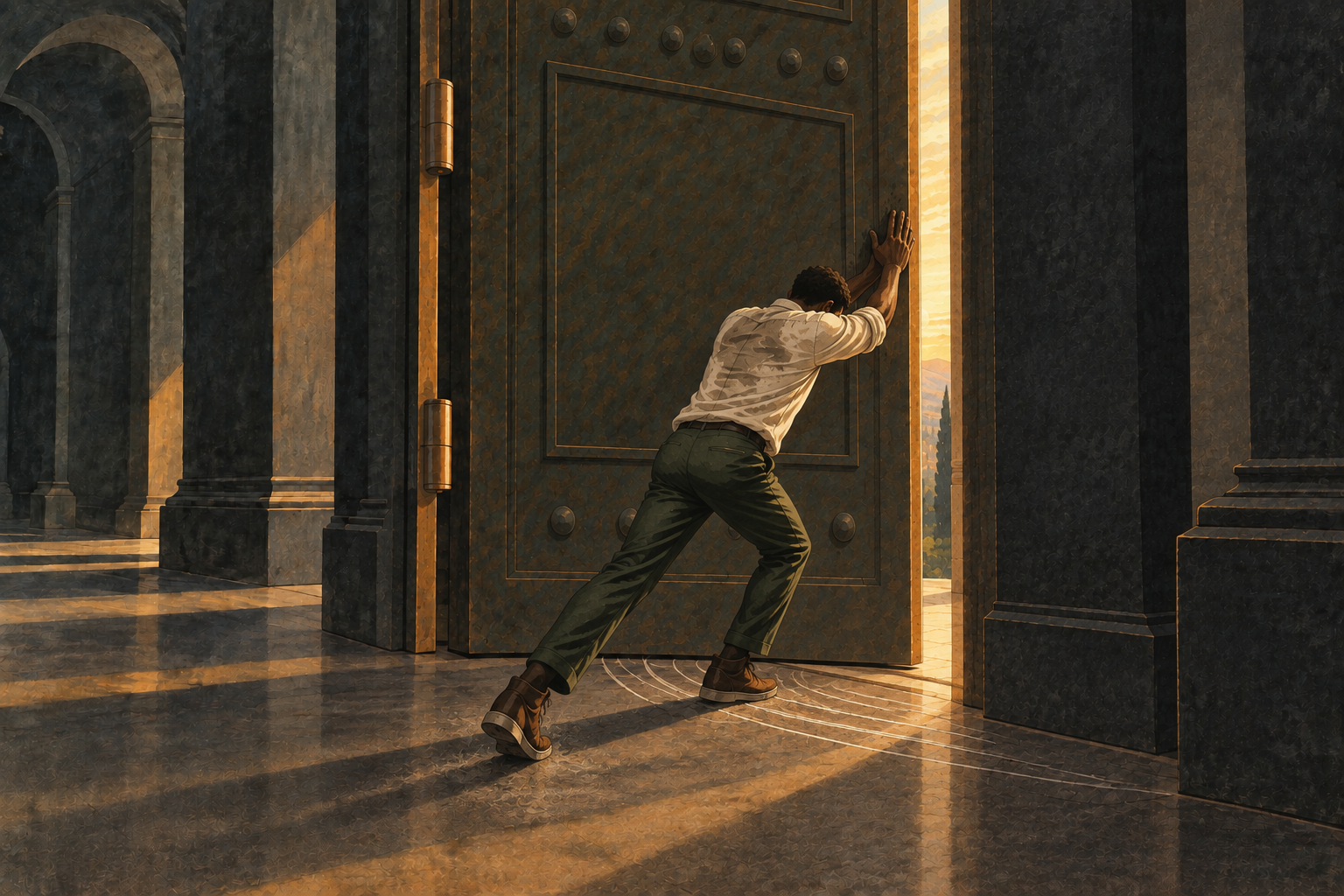
The problem is that difficulty does not carry one clear message. A locked door and a heavy door both resist the hand. The sensation is similar even though one cannot be opened and the other has simply not moved yet. Much of adult judgment is learning not to confuse them.
Nigeria has given ease a spiritual vocabulary
This is not only a Nigerian mindset, but we give it a particularly Nigerian vocabulary. We talk about grace, favour, helpers of destiny, open doors, and things falling into place. I believe in those things. A life can change because the right person remembers your name in a room you could not enter.
An opportunity can arrive that no amount of planning would have made it a possibility. Only an arrogant person looks at their life and concludes that effort explains every good thing in it.
The trouble begins when we use ease as evidence of favour. Listen to the shape of many testimonies. There was lack, then abundance. There was obscurity, then visibility. There was an application, then acceptance.
This is not necessarily dishonest; public stories have to compress time. Nobody can stand before a congregation and narrate four thousand ordinary Tuesdays.
But compression changes the lesson. The years of preparation disappear, along with the embarrassing attempts, the corrections, the relationships slowly built, and the small competences that later made an opportunity usable.
What remains is a clean movement from struggle to breakthrough. A younger person listening can easily conclude that struggle belongs to the season before grace, while ease is how you recognize that grace has finally arrived.
The religious stories many of us inherited are far less tidy. Moses’ calling sent him toward Pharaoh. David’s anointing did not prevent the wilderness. Paul’s conviction did not produce a convenient life. In those stories, calling did not remove resistance; it gave the resistance a context.
Grace did not appear as an exemption from labour, uncertainty, or pain. It appeared as the strength to stay inside a difficult assignment without allowing the difficulty itself to decide whether the assignment mattered. The road did not become easy enough to confirm the calling. The person had to develop enough endurance, judgment, and courage to carry it while the outcome was still unclear.
Our hunger for ease is not irrational
I also do not think Nigerians love ease because we are lazy. That explanation is too cheap. Nigerians work absurdly hard, often at things that should not require hard work at all.
You can be doing serious intellectual work while also wondering whether NEPA will let you finish it. You can be building a company while negotiating with infrastructure that should have been invisible.
A payment fails, a road steals three hours, equipment costs several times what it costs elsewhere, a public office turns a basic process into a pilgrimage, and the simplest plan grows extra limbs before noon.
When ordinary life contains that much pointless resistance, ease begins to feel morally beautiful. Of course people want a soft life. Hardship has been oversold to people who did not volunteer for it.
There is nothing noble about wasting human energy on bad roads, broken institutions, unreliable power, arbitrary bureaucracy, or preventable poverty. Electricity, payments, business registration, and access to your own money should not consume the energy required to use them.
The mistake is carrying that correct instinct into every other part of life. Learning an instrument is not difficult for the same reason registering a business is difficult. One is hard because a system has failed you.
The other is hard because your ear, hands, timing, judgment, memory, and taste have not yet become what the work requires. Bureaucratic friction should be removed. Developmental friction is the process by which capacity is formed. Both are inconvenient, but they are not the same kind of inconvenience.
I started out terrible at Music
At one point in my music journey, I was so horrible that somebody told me I would never learn the instrument. I wish I could make the person look stupid from the beginning, but that would be dishonest.
They were responding to what was in front of them, and what was in front of them was bad. They were not wrong about the player I was. They were wrong to assume that player was final.
That distinction is obvious now and was almost impossible to see then. My ears could recognize more than my hands could produce, which is a miserable place to be because you are good enough to hear yourself failing and not yet good enough to stop.
I could hear the music I admired. I could also hear the distance between that music and whatever I was doing to the instrument. On a bad day, the distance felt like information about my limits. On a better day, it felt like the normal humiliation of being a beginner. The sound itself did not tell me which interpretation was correct.
This is the part that disappears when people tell their stories later. Once an outcome is known, every previous difficulty is recruited into the plot. The insult becomes motivation. The rejection becomes redirection.
The years of being ordinary become preparation. But while you are living those years, it sure doesn’t feel like it, the only feedback is; you suck! You do not know whether you are in the difficult first chapter of a good story or refusing to accept an ending that has already become obvious to everybody else.
You can’t connect the dots looking forward; you can only connect them looking backwards. So you have to trust that the dots will somehow connect in your future.
I kept playing. Not because I had received some private assurance that I would become good, and not because every practice session left me inspired. Many of them did not.
I kept playing because I wanted to and I did so long enough for me to suck less. My timing improved. My hands became more reliable and now I can do the things that before felt like wishful thinking.
Things that once required all of my concentration became available without panic. I started hearing more, then doing more with what I heard. Other musicians could trust me with more responsibility. The progress was not dramatic enough to become a testimony every week, but it was there.
Would I have preferred the Mozart version of the story? Of course. Who would not want to say they sat at an instrument as a child and everybody immediately recognized a prodigy? It is far more flattering to believe the gift arrived whole and the world simply had to discover it.
I would love to tell you that music was always natural to me, that excellence was present from the beginning waiting for an audience, and that the people who doubted me were simply too blind to see what was obvious. But that is not my journey.
I have come to think about this through amor fati: not merely accepting your fate, but learning to love the life that is holistically yours. I do not take that to mean every humiliation was good, every delay was necessary, or that suffering should be decorated after the fact so we can bear looking at it.
It means I have stopped negotiating with reality as though my actual life is the inferior draft of the one I deserved. I was not a prodigy. I was bad, then less bad, then useful, then trusted, and I kept becoming. There is nothing wrong with that sequence simply because it lacks the glamour of early genius.
Some people receive evidence of their gift very early. Mine required a longer introduction. The difficulty was not an administrative error in my life, and the slow beginning did not mean I had entered the wrong room.
This was simply how music became mine: not as immediate genius, but as a relationship built through attention, correction, embarrassment, repetition, and eventually competence. And I love my journey; warts and all.
Today, I play keys and piano for records and live rooms. I arrange music, produce, score scenes, and provide musical direction. Some of that work is on my music page. The point is not that I heroically ignored everybody and proved that self-belief conquers reality.
That is another lie. Critics can be right. Wanting something badly does not create ability, and repeating a mistake for ten years does not flip the mistake on its head.
What saved persistence from becoming delusion was that it kept meeting correction. I was not pressing the same wrong keys with greater confidence and calling that faith. The work was changing me, slowly enough to irritate me but clearly enough to justify another season.
That is the evidence I trust now. A difficult road does not need to become easy immediately, but something should be becoming more possible: your understanding, your capacity, the quality of your questions, the usefulness of the feedback, or the work itself.
The world has secularized the same superstition
Outside Nigeria, the vocabulary changes while the belief survives. Favour becomes alignment. Calling becomes passion. The spiritual language is removed, but the structure remains: the right path is expected to announce itself by cooperating with you.
The internet has made this worse because we usually meet people after their struggle has become marketable. Nobody is filming the musician during the years when the playing is not interesting enough to watch. The founder becomes visible when there is funding to announce.
The writer appears with a book, not with the folder containing versions that should never be published. By the time the work reaches us, its rough history has been edited into a personality trait called talent.
Ed Sheeran once played an old recording of himself singing as a child. It was badly out of tune. As RTÉ reported, the clip offered little audible evidence of the singer he would become. The recording does not prove that every poor singer is an undeveloped star. It proves something more modest and more important: early performance is unreliable evidence about eventual capacity.
We use the word talent to compress a timeline we did not witness. We hear control, phrasing, confidence, and judgment in the finished artist, then imagine those qualities existed in miniature from the beginning. I understand why. The alternative is uncomfortable.
If gifted people can initially look ungifted, then the beginning cannot reassure anybody. You may have something and still look ridiculous. You may also look ridiculous because you are ridiculous. Time, work, correction, and evidence have to separate the two.
Difficulty is data, not direction
Difficulty is information, but it is not an instruction. It tells you that the thing is demanding more capacity, time, knowledge, support, or sacrifice than you currently possess. It does not tell you whether to continue. We keep asking it to do that because uncertainty is exhausting and we would rather have a sign.
Some people turn every difficult season into a stop sign. The moment the work becomes embarrassing, lonely, repetitive, or slow, they call it misalignment. They move from path to path preserving the pleasant feeling of being promising, because staying anywhere long enough would eventually expose the parts of them that promise cannot carry.
Other people make the opposite mistake and become loyal to suffering. The business is failing, the method has stopped teaching them anything, the relationship is destroying them, but leaving would make the pain feel wasted. So they rename damage as sacrifice and continue. One person thinks hard must mean wrong. The other thinks hard must mean important. Both are trying to make the feeling answer a question that only closer attention can answer.
There is more than one kind of hard
Part of the confusion is that we use one word for several experiences that have almost nothing in common.
There is the hardness of newness. Your mind and body have not built the pathway yet, so every small action demands conscious effort. A beginner guitarist changes chords too slowly. A new programmer has to remember syntax that an experienced developer no longer sees.
The first public speech consumes attention that a practiced speaker can spend noticing the room. Nothing mysterious is happening. The thing is strange, and repetition is making it familiar. This sort of hard usually responds to instruction, correction, smaller exercises, and time.
Then there is the hardness that arrives after you have become competent. You can already do the thing, but your taste has moved beyond your ability. Your old methods still produce respectable work, which makes it difficult to abandon them, but respectable is now the ceiling.
I wrote about this in Good Enough Is the Enemy of Great. Growth at that stage often requires the insult of becoming awkward again. You are not a beginner, but you must borrow the beginner’s willingness to look foolish.
There is also the hardness imposed by the environment, and this one is easy to moralize if you have been protected from it. A Nigerian child learning music without reliable electricity, access to an instrument, good teaching, or time protected from survival is not facing the same test as a child with a piano at home and private lessons.
Calling both outcomes discipline turns inequality into a personality test. Some difficulty needs practice. Some difficulty needs money, policy, equipment, migration, mentorship, community, or the removal of an obstacle that should never have existed. Talent cannot metabolize every deprivation, no matter how inspirational the caption beneath it.
And yes, sometimes the road is wrong. Nothing useful is accumulating. The feedback does not change because the work does not change. People who understand the field can explain, specifically, why the method cannot produce the desired result. The goal asks you to betray things you should not betray, or the cost keeps growing while your capacity and understanding remain exactly where they were.
This is why the question cannot end at, “Why is this so hard?” I want to know what the hardness is doing. Is it teaching me, enlarging me, exposing a missing skill, revealing a broken system, or merely consuming me? The answer may still be unclear, but at least that question looks at the work instead of turning discomfort into prophecy.
Persistence without revision is only repetition
I am suspicious of famous persistence stories because we tell them backwards. Once the company succeeds, every early failure becomes proof that the founder had vision. Once the artist becomes great, every rejection becomes proof that the gatekeepers were blind. Success cleans up the evidence and makes stubbornness look wise from the first day.
YouTube is a good example because it now feels like an obvious product. It is difficult to imagine the internet without it, so we unconsciously assume people must have wanted it immediately. They did not.
In an oral history for the Computer History Museum, Steve Chen remembered the anxiety after the site launched: there were no users and nobody was uploading anything. The founders were so worried that they offered women on Craigslist $20 to upload dating videos. Even that failed. Nobody responded.
Imagine sitting with that silence after building what would become YouTube. If ease were confirmation, the market had already spoken. Yet the founders did not respond by chanting harder over the same idea.
They widened the site beyond video dating, allowed people to upload any kind of video, and helped those videos travel through places where people already gathered, including MySpace. Before the end of 2005, YouTube says, the site was receiving millions of views a day.
The first idea was not entirely right, and the early rejection was not entirely right either. There was a valuable thing buried inside what one may consider as an underwhelming first launch.
If they had worshipped the original plan, stubbornness might have killed YouTube. If they had treated poor adoption as a prophecy, discouragement might have killed it. What saved the company was not pure belief. It was belief loose enough to learn.
Elon Musk reached a much more expensive version of this uncertainty in 2008. SpaceX had failed to reach orbit three times. Tesla was consuming cash during a financial crisis, and Musk was running out of money to keep both companies alive.
NASA’s history of its commercial space programme records that Falcon 1 finally reached orbit on its fourth attempt in September 2008. Musk has said that fourth rocket was the last launch SpaceX could afford.
It is easy to look at SpaceX now and turn the fourth launch into destiny. After the third failure, there was no destiny visible. There was wreckage, very little money, a team that had to find out what had gone wrong, and another machine that might also explode.
Musk kept pushing and committed his remaining reserve capital to Tesla, a period he later described as particularly awful in an interview about the companies’ early years.
But pushing was only half the story. Engineers had to make the fourth rocket different from the first three. Reality does not reward conviction for being sincere; a rocket that is wrong still falls out of the sky.
James Dyson’s 5,127 vacuum prototypes make the same point in a less dramatic form. Dyson’s account describes four years of development before the design was ready for production.
The number is usually repeated as a monument to endurance, but attempting the same failed design 5,127 times would have been madness. Each useful prototype had to expose something the next one could change. Failure was not progress merely because it hurt.
Katalin Karikó’s long work on mRNA survived grant rejections, institutional doubt, and a demotion at the University of Pennsylvania. In her Nobel Prize interview, she described continuing because she still had a laboratory bench and could keep working.
That can easily be flattened into a story about believing in yourself, but science is unmoved by self-belief. Karikó had experiments, results, collaborators, and questions that became more precise. Beneath the public rejection, the work itself was still speaking.
That is the part I care about in all these stories. They were stubborn, certainly, but their stubbornness was in conversation with reality. The plan could change. The machine could change.
The experiment could correct the belief. Motivational culture removes this part because “never give up” fits neatly on a wall. “Continue, but remain humble enough to become a different person and perhaps pursue a different version of the thing” does not.
How do you know when to continue?
You never know with the certainty that hindsight pretends was available. There is no test that can tell a struggling musician whether they are five years away from mastery or five years into avoidance. If that test existed, there would be no courage in continuing and no wisdom in leaving. We would simply check the result.
I start by trying to make the difficulty specific. “This is hard” is almost useless. Is my timing bad? Is my technique wrong? Do I lack knowledge, access, money, courage, a teacher, a market, or enough time? A problem with a name can be trained, funded, redesigned, negotiated, or accepted. A foggy sense that the universe is resisting me can mean whatever my mood wants it to mean that morning.
Then I look for accumulation. Can I do anything now that defeated me six months ago? Are the mistakes becoming more sophisticated, or am I still making the first mistake with new vocabulary? Are people whose judgment I respect trusting me with harder work? Progress can be slow and still leave evidence. The evidence may be small, but a living thing normally changes.
I also want to know whether feedback is allowed to disturb me. If every critic is a hater, every rejection is jealousy, and every failure sends me back to the same method, then my persistence is no longer courage. It is insulation. Faith that cannot survive correction is often ego wearing religious clothes.
The cost matters too, especially who is paying it. There is something dishonest about calling an ambition noble while your family absorbs permanent neglect, your employees absorb humiliation, and your health absorbs damage you refuse to address.
A worthy goal does not make every price worthy. Sometimes the clearest sign that a pursuit has become corrupt is that the person pursuing it no longer pays the largest share of the bill.
Finally, I ask what remains valuable if recognition is late. Money and recognition matter; I do not trust advice that pretends otherwise, especially advice given by people who already have both.
But if the only attractive part of the work is the imagined applause at the end, the ordinary middle will feel like theft. Most serious work contains far more middle than applause.
None of these questions produces certainty. They only keep persistence answerable to reality. You can change the method without betraying the goal. You can also change the goal without declaring all previous effort wasted.
Sometimes staying teaches you how to continue, and sometimes it teaches you what you should have been doing instead.
Ease is an outcome of mastery, not proof of destiny
The irony is that serious practice eventually produces the ease we mistakenly expect at the beginning. A pianist’s hands move before the audience has finished wondering how.
An experienced engineer can see the failure hiding inside an architecture while everybody else is still admiring the diagram. A writer removes the sentence that took two hours to produce and leaves a page that looks as though it arrived whole.
That kind of ease is real, but it is not innocence. It has a history. It contains all the moments when the hand hesitated, the ear missed something, the judgment was late, and the person had to stop and begin again.
Mastery is partly the concealment of its own construction. The better somebody becomes, the harder it is to imagine them being bad, which is why we keep mistaking the finished appearance for the original condition.
I know there are things my hands can do on an instrument now that once felt unavailable to me. When they happen easily today, I do not receive that ease as proof that music was always destined for me. I remember that the same hands once made somebody conclude that I would never learn.
The ease is not evidence that difficulty was absent. It is evidence that difficulty can be converted into capacity when practice is honest enough and time is allowed to do its work.
Do not ask difficulty to prophesy
I have already argued that happiness is too small a ruler for measuring a life. I think ease is too small a compass for the same reason. It describes how a road feels beneath your feet today. It cannot see where the road ends.
This does not mean we should make life harder to prove seriousness. Remove stupid friction wherever you can. Find the better teacher. Buy the tool if you can afford it. Build the system. Rest before exhaustion makes every decision look like a revelation.
Leave the situation that is harming you and producing nothing except a greater tolerance for harm. Nigerians have endured enough unnecessary hardship; I have no interest in manufacturing more and calling it character.
I only want us to stop demanding that growth flatter us while it is still rearranging us. Sometimes the work will embarrass you. Sometimes the business will open to silence.
Sometimes the instrument will make your hands look foolish. Sometimes you will pray and still have to return the next morning to a problem that did not disappear overnight. None of those experiences, on its own, tells you to stay. None of them, on its own, tells you to leave.
The image I keep returning to is the heavy door. From the side where you are pushing, a heavy door can feel locked. You lean into it and nothing seems to happen. Then perhaps there is a sound from the hinge, a thin line of light, a small movement you might miss if you expected the whole entrance to swing open at once.
That movement is not a promise that everything beyond the door will work. It is simply evidence that the door is not exactly where it was.
That is often all we have while doing difficult work: not certainty, not a voice from heaven, and not the clean encouragement that will later appear in the testimony.
We have the quality of the feedback, the changes in our capacity, the honesty of the cost, the small movement in front of us, and enough judgment to decide whether to push again.